
Outclassed: How the Left Lost the Working Class and How to Win Them Back
(St. Martin’s Press), Joan C. Williams
While arguing for a populist economic program as a centerpiece of progressive Democratic campaigning, Joan Williams also explains why that alone cannot win back working-class voters of all colors. Deep cultural differences between working-class voters and progressive educational and political elites, to which the elites are blind, have led to class resentments that have been exploited by the Right. Williams argues for class-cultural competence on the part of the professional middle class and explains both why that is politically necessary and how to achieve the kind of cultural awareness that can open up dialogue around progressive economic ideas. Besides politics, Outclassed examines both the economic conditions and positive cultural traits in working-class life today, and illustrates how both can be appealed to in tandem to advance an effective progressive movement. Arlie Hochschild endorses it as an “eye-opening, punchy, highly important book.”

Class Warfare in Black Atlanta: Grassroots Struggles, Power, and Repression under Gentrification
(U. of North Carolina Press), Augustus Wood
With the passage of the Voting Rights Act in the 1960s, the Black working-class in Atlanta, and across the South, was newly enfranchised, and it used its new power to elect a series of Black political leaders. Augustus Wood argues that “Black and white elites responded to an energized and politicized Black working class by forging a public-private partnership power bloc that included the small but growing Black political leadership, expanding the racial class contradictions in Black Atlanta.” This bloc got state funding shifted away from public services in favor of gentrification projects that demolished subsidized housing. Today, according to Wood, Atlanta’s city core has been “thoroughly gentrified, and the ability of Black working-class Atlantans to organize and build power ha[s] diminished significantly.”

They Call You Back: A Lost History, A Search, A Memoir
(U. of Arizona Press), Tim Z. Hernandez
The winner of the most recent WCSA Tillie Olsen Award, Tim Hernandez’ They Call You Back is a sequel to his acclaimed documentary novel All They Will Call You. The first book chronicled Hernandez’ efforts to locate surviving family members of the 28 Mexicans killed in the 1948 plane crash at Los Gatos Canyon. This book comes as Hernandez finds the victims’ voices still calling him and the victims’ families sometimes grateful and sometimes stunned that someone is giving their lost family members a historical voice. Hector Tobar, author of Our Migrant Souls, says: “Tim Z. Hernandez completes an ambitious and essential trilogy that has helped redefine the history of California’s Central Valley, and of the Mexican and Mexican American farmworkers who labor there. Haunting and beautiful, these works will stay with you long after you have read the last page.

The Strike that Changed Maryland’s Wilderness County
(Hard Ball Press), Len Shindel
We don’t often think of Maryland as being part of Appalachia, but its westernmost county is an Appalachian wilderness with a very low, very white, and very rural population. In 1970 the Garrett County road workers went on strike over their right to form a union and negotiate wages and benefits comparable to other road workers in the state. They were opposed by the local business class, politicians, and even many local farmers, but they held out for 8 months before they won. Veteran organizer Len Shindel tells their story, including how they got by so long without a paycheck. The publisher hopes Shindel’s oral history will give other workers in rural, deep red areas the courage and confidence to push back against exploitative employers.

The Book of Jobs: Poems About Work
(One Art Poetry), Edited by Erin Murphy
Available online, The Book of Jobs is the result of a call for work about work by One Art Poetry. The call netted over 3600 submissions. In her introduction, the editor writes: “In these pages you will find poems about a wide range of jobs, from coal miners to caregivers, farmers to flight attendants, union organizers to Uber drivers, engineers to exterminators, teachers to tech workers, artists to athletes, doctors to dunking booth clowns. You will also find the work of nonhumans—bees, voles, meerkats, birds, earthworms, donkeys, whales, dolphins, and dogs—along with the natural world itself in which ‘a little earth pushes up/ a little plant life also.’” This online collection is the “soft launch” of the project, with an open-access version of the book forthcoming from Penn State University Press in 2026.

Strike While the Needle Is Hot
(Common Notions), John MacPhee & Kennedy Block
The “needle” in the title of this book refers to the needle used to play vinyl records back in the day, and John MacPhee and Kennedy Block restore the words of a wide variety of recorded music that reflected and spurred on labor movement struggles in the 1960s, ‘70s, and ‘80s. The publisher describes it as “a broad overview of how militant unionists used music as a tool of struggle, as well as fine details about specific worker revolts that would be lost to history if they hadn’t captured them on small discs of vinyl.”
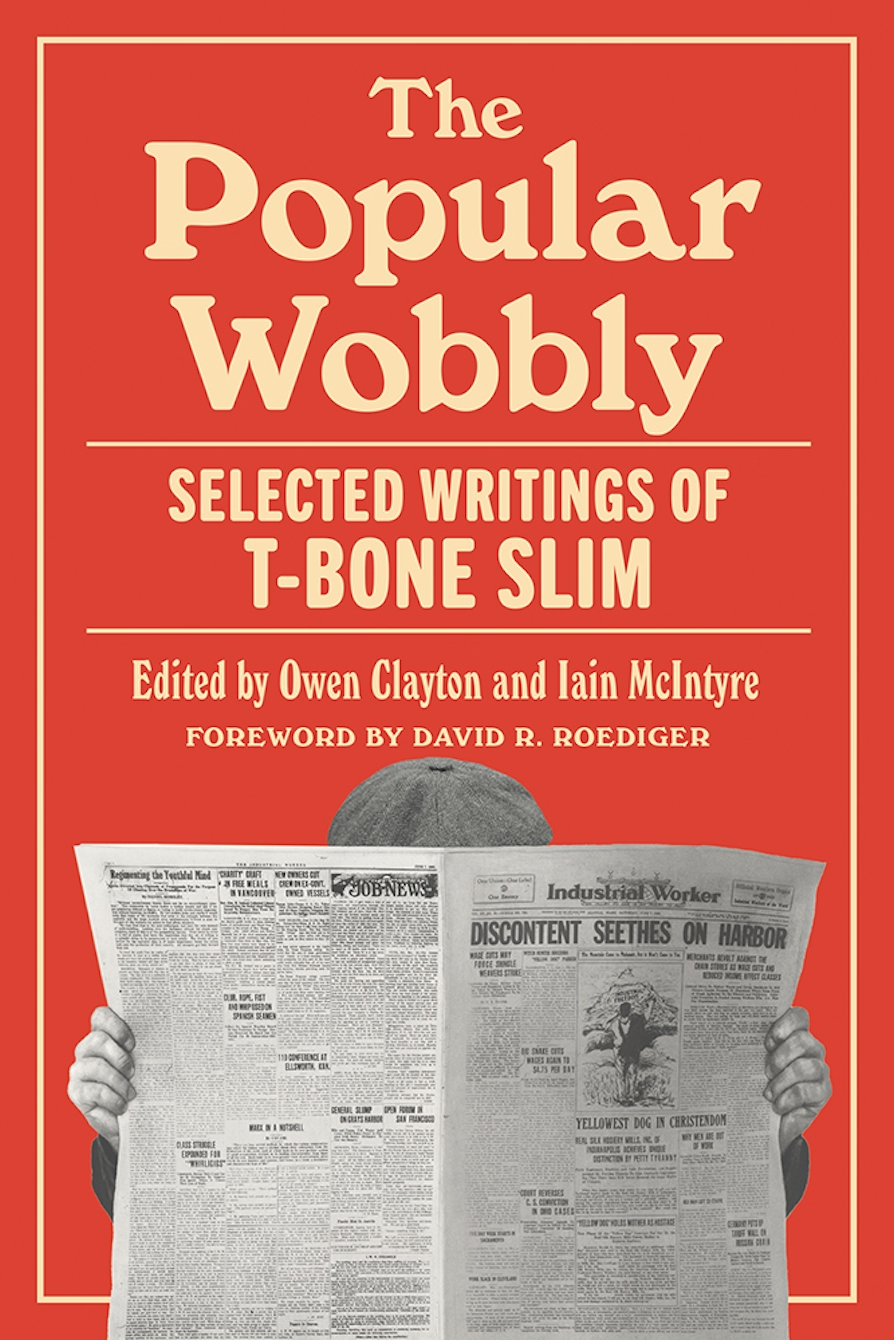
The Popular Wobbly: Selected Writings of T-Bone Slim
(U. of Minnesota Press), Owen Clayton & Iain McIntyre, editors
T-Bone Slim was among the most popular and talented writers who belonged to the Industrial Workers of the World (the IWW or Wobblies) in the first half of the 20th century. Most famous for songs about riding the rails as a hobo during the Great Depression, he has been called “the laureate of the logging camps.” His humorous, polemical editorials were mostly published in IWW publications from 1920 to 1942, when he died. Relatively little is known about Slim, but WCSA president-elect Owen Clayton and Iain McIntyre stitch together what is known into what the publisher describes as a “vivid portrait that adds valuable context for the array of writings assembled here.”

The Pandemic and the Working Class: How US Labor Navigated COVID-19
(U. of Illinois Press), Nick Juravich & Steve Stiffler, editors
This collection of essays explores not only what happened to workers during the COVID-19 pandemic – the loss of jobs for some and brutal hours of work in unsafe and deadly conditions for others – but also the worker upsurge that occurred as we were coming out of the pandemic. The publisher promises a cornucopia of detailed investigations: “Sections of the book focus on specific impacts and government efforts to restructure the economy; the dramatic effect of the pandemic on the hospitality industry; educators’ response on behalf of themselves and their students; frontline healthcare workers; and the innovative forms of labor organizing that emerged during and after COVID.”

Fighting Toxic Ignorance: Origins of the Right to Know about Workplace Health Hazards
(ILR Press), Alan Derickson
Not knowing that you are working with dangerous substances makes those substances more dangerous, and this book recounts the numerous struggles among workers to identify and warn against the toxicity that came with various kinds of work. By the 1970s, when national law finally started to require employers to inform workers of health hazards, some 100,000 Americans were killed by occupational disease. According to the publisher, the book “covers a broad range of dangerous substances, deals with a large share of the national workforce, and illuminates the many ways that activists endeavored to see that warnings reached workers.

(Iota Press), Eric Johnson
Journeyman’s Dues is a memoir of Eric Johnson’s nearly 20-year span of work as a union carpenter on the West Coast. Following the transformation from apprentice to journeyman and the diverse projects and people he engages along the way, the book is an inside consideration of work and workers. John Beck writes of the book that “the cast of characters changes with the worksite and the year, but there is an abiding belief in non-hierarchal solidarity that waits to see what you can do with your hands and head.”

Atlantic Cataclysm: Rethinking the Atlantic Slave Trades
(Cambridge U. Press), David Eltis
This book offers a two-thousand-year account of the trafficking of people, focused specifically on the Atlantic slave trade from Africa. David Eltis argues that most enslaved people were taken to the Portuguese and Spanish parts of the American continents, not to the Caribbean or US. But the book also traces “the mass involvement of people in the slave trade business from all parts of the Atlantic World [and] examines the agency of Africans and their experiences in the aftermath of liberation.”
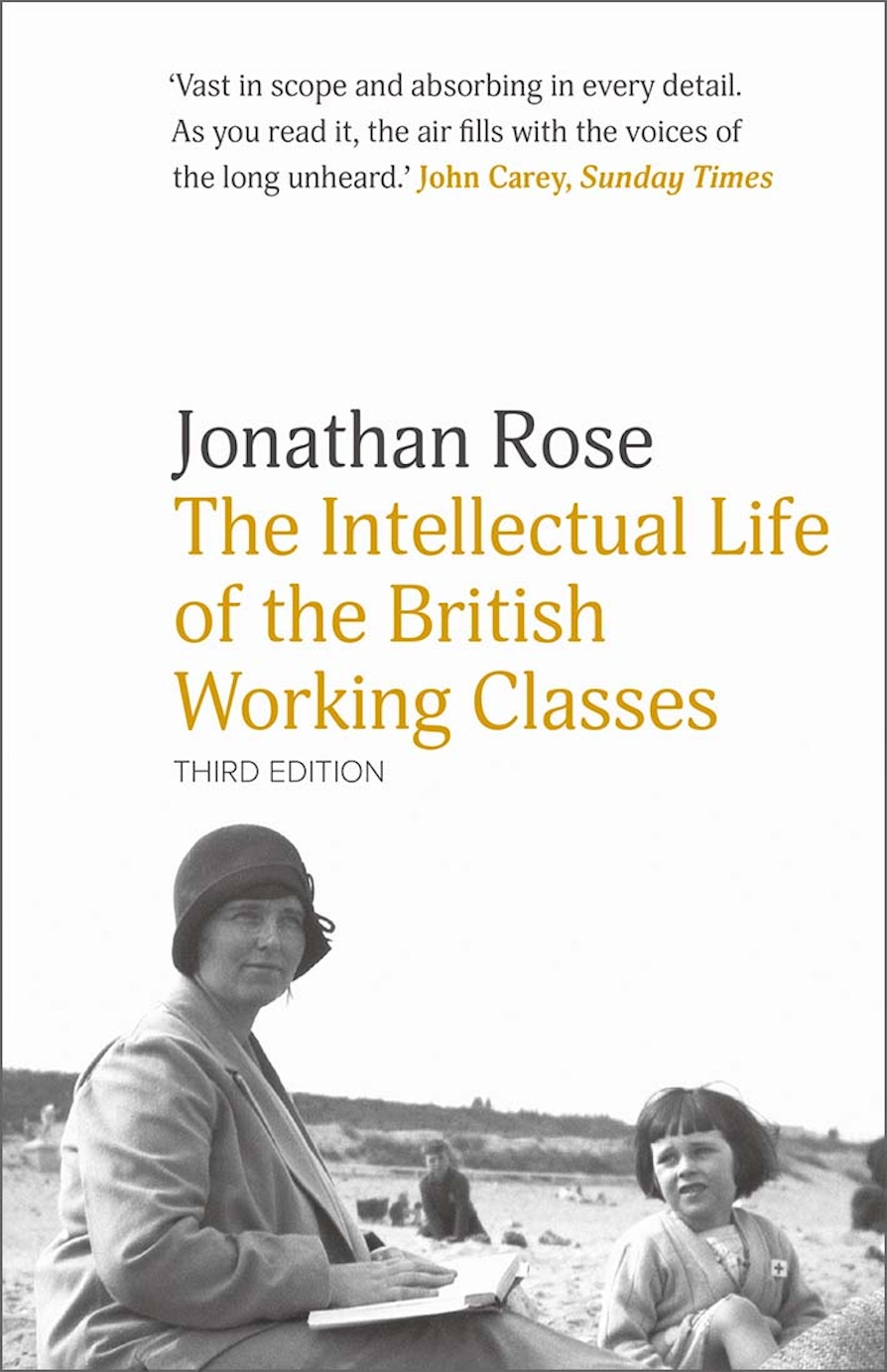
The Intellectual Life of the British Working Classes
(Yale U. Press), Jonathan Rose
This book came out a few years ago, but we missed what should be an important work for Working-Class Studies. It covers the intellectual lives of working classes in Britain from preindustrial times up to the 20th century, using memoirs, library registers, social surveys, and archives to “rehabilitate the democratic idea that the best of culture is for everyone.” The Economist called it “sharply original” and praised Rose for rediscovering “a tradition of self-education which recent academic cultural criticism has tended to devalue.” According to the publisher, the book “uncovers which books people read, how they educated themselves, and what they knew.”
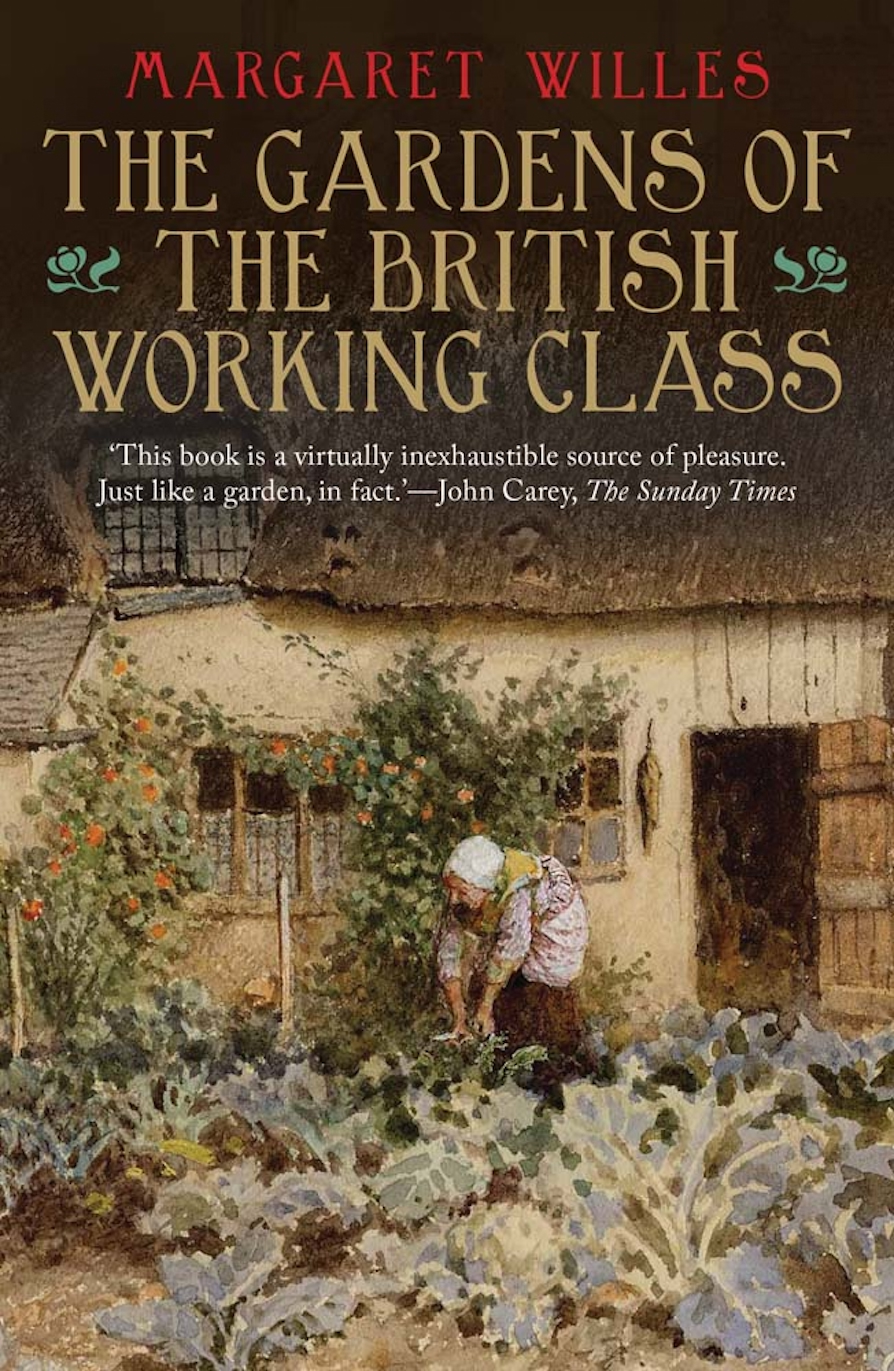
The Gardens of the British Working Class
(Yale U. Press), Margaret Willes
Did the working classes devote what gardens they had only to vegetables and maybe fruits, as some scholars contend, or did they also find room for flowers and scrubs? This question is answered by Margaret Willes’ investigation of 400 years of working-class gardens in Britain, in which she “unearths lush gardens nurtured outside rough workers’ cottages and horticultural miracles performed in blackened yards, and reveals the ingenious, sometimes devious, methods employed by determined, obsessive, and eccentric workers to make their drab surroundings bloom.” The volume is heavily illustrated with paintings, drawings, photos, and other memorabilia.

(She Writes Press), Mattea Kramer
An American Fiction Books Award winner for the Psychological Thriller category, The Untended is the story of waitress and recreational boxer Casch Abbey. When she injures her foot and can’t work, her resources shrink. When she becomes addicted to painkillers after her accident and then the drug is taken off the market, her options for relief become darker and darker. Writer Liz Harmer says: “I couldn’t look away. The Untended is a feat of storytelling, with a narrator you can’t help rooting for caught up in a system that might grind her up. With all the tension of thriller paired with the deeply felt poetry of lyrical realism, I couldn’t admire this novel more.”

A Wide Net of Solidarity: Antiracism and Anti-Imperialism from the Americas to the Globe
(Duke U. Press), Anne Garland Mahler
This is a history of the Anti-Imperialist League of the Americas (LADLA), founded in 1925 in Mexico City by a group of multinational activists from South and Central America, the Caribbean and the US. LADLA brought together labor unions, agrarian organizations, and artists groups from many nations. According to the publisher, “Drawing on extensive archival research, Mahler uncovers LADLA’s role in fostering Black, Indigenous, and immigrant-led resistance movements while positioning these struggles within a broader hemispheric and global struggle against the racialized accumulation of capital.”

The Hard Work of Hope: A Memoir
(ILR Press), Michael Ansara
Michael Ansara is a veteran organizer from the 1960s on and was a key architect of Massachusetts Fair Share. His memoir recounts his early experience as an organizer in the Civil Rights Movement and anti-Vietnam war protests, reflecting on both his mistakes and successes and those of the broader movements. The publisher promises that the book addresses vital questions for today’s organizers: “How does a movement build support when large parts of the country are opposed to its goals? How do you connect with people who disagree with you? How do you build organizations that unite across racial lines?

The Angle of Falling Light: A Novel
(Seven Stories Press), Beverly Gologorsky
Gologorsky’s fourth book is set in post-9/11 New York, specifically Long Island and the Bronx. The protagonist, Tessa, struggles to find her way as the family around her struggles too—with PTSD, financial woes, and addiction. Tess must fight for herself, to remember herself, amid their collective difficulties. Jan Clausen writes: “Set during the ‘forever wars’ that followed 9/11, The Angle of Falling Light movingly explores the demons that survivors must wrestle with in the wake of tragedy. Beverly Gologorsky brings us a great cast of characters, at their center three working-class women trying to shape lives of their own in a world that seems to promise them nothing but deadening repetition. Brave and faltering, they face daunting conundrums of love, care, and the pull of freedom. How do we live past the terrible knowledge that we cannot always help those we cherish the most?”
Lessons from Eviction Court: How We Can End Our Housing Crisis
(ILR Press), Fran Quigley
Fran Quigley is an evictions lawyer who is in eviction court every week, standing alongside people who are losing their homes. She contends that evictions do not occur in other nations as they do in the US, that they did not used to be the norm here, and that we can end evictions and homelessness if we have the political will. According to the publisher, Quigley begins with the stories of her struggling clients in order to introduce specific reforms that could end the crisis of homelessness in the US.

Exiles in New York City: Warehousing the Marginalized on Ward’s Island
(Columbia U. Press), Philip T. Yanos
Ward’s Island is in the East River lodged between Manhattan, Queens, and the Bronx, and according to Philip Yanos, for two centuries it has been a “dumping ground for society’s most marginalized―the unhoused, recent immigrants, and people diagnosed with mental illnesses.” Today it houses two psychiatric hospitals, homeless shelters, a residential substance-abuse program, and more than 1,000 people. Yanos is a clinical psychologist who grew up on Ward’s Island, and he draws on that experience as he searched archives and interviewed current residents and staff. The result is a history of the island alongside the history of urban mental health systems in the United States” and “a new lens on the city’s past and present from the perspective of the marginalized.”

Making the Woman Worker: Precarious Labor and the Fight for Global Standards, 1919-2019
(Oxford U. Press), Eileen Boris
The International Labour Organization was founded in 1919 along with the League of Nations, and until World War II it focused almost entirely on male industrial workers in Western economies in its efforts to establish labor standards. In this book, Eileen Boris traces that history as background for an account of how women workers got themselves included in the ILO’s studies and standard-setting. According to the publisher, “Over time, the ILO embraced non-discrimination and equal treatment. It now promotes fair globalization, standardized employment and decent work for women in the developing world. In Making the Woman Worker, Eileen Boris illuminates the ILO’s transformation in the context of the long fight for social justice.”

The Collected Stories of Pietro di Donato
(Bordighera Press), Edited by Fred Gardaphe
Di Donato’s novel Christ in Concrete is well-known and well-loved by scholars of working-class literature; his other works are lesser-known. This collection moves beyond the novel with a series of short stories—several focused on working-class characters and settings–rich in Di Donato’s poetic, embodied, style. From the press: “Di Donato hits where you live, to remember until you die.”