
Working-Class Girls Don’t Become Artists: Looking at Art and Class
(U. of Illinois Press), Janet Zandy
Working-Class Studies pioneer Janet Zandy profiles nine artists whose work “aligns with the history and living conditions of working-class people”: Kathe Kollwitz, Elizabeth Catlett, Ruth Asawa, Marilyn Anderson, Milton Rogovin, Mark Rogovin, Jens S. Jensen, Ralph Fasanella, and Raymond Mason. Linking labor and art, Zandy reveals the class biases in systems of art curation, categorization, and expertise, and with her portraits opens “larger conversations about class and artistic formation, intent and accessibility.” For Zandy art is “not a rare fruit to be plucked by the chosen few [but] a human necessity and crucial for the sustenance of democracy.”

Paper Girl: A Memoir of Home and Family in a Fractured America
(Penguin Press), Beth Macy
This is a best-selling book about working-class life in one small Ohio town 40 years ago and now, and the history of that one town reveals a fractured American landscape that is widespread but seldom seen. Beth Macy grew up in Urbana, Ohio, and was a paper girl delivering the daily newspaper to people’s homes. In doing so, she widened her world by knowing the town so well, and she uses those memories to tell the story of her family and town. It was never a bed of roses, but in returning 40 years after she left and became a distinguished journalist, it is devastating to see the decay that has happened and is happening to the place and people she loves.

The Personal Life of Debt: Coercion, Subjectivity, and Inequality in Britain
(Bristol U. Press), Ryan Davey
There is a catch-22 in much of working-class life. Where wages are insufficient to provide daily wants and needs, workers are forced to borrow, but because it is expensive to borrow and their wages are insufficient, they find it impossible to pay their debts. Ryan Davey analyzes this common phenomenon in the lives of men and women living on a southern English housing estate. Described as “the first full-length ethnography of debt problems in Britain,” The Personal Life of Debt explores in intimate detail the everyday lives of indebted people, both the hopelessness of their plight and their ingenuity in getting by.

Maximum Leverage: From the Street to the Picket Line
(Hard Ball Press), Phil Cohen
This is the story of the two lives of Phil Cohen. The first is about childhood in the mean streets of New York City and then his early life as a young adult as a gypsy cab driver in neighborhoods too dangerous for regular cabs, and eventually to managing a cheap hotel, where he helps the impoverished residents with law enforcement, health care, and welfare. The second life of Phil Cohen is as a lead organizer for a major trade union, where he defeats union busters, leverages good contracts with hostile employers, and even breaks the Ku Klux Klan’s control of a union local. According to the publisher, “Written as action dramas with engaging character studies, the stories thrust readers into the whirlwind of vicious labor disputes while providing an audience-friendly understanding of labor law and asymmetric organizing tactics.”

The Wage Standard: What’s Wrong in the Labor Market and How to Fix It
(Dutton), Arindrajit Dube
Arindrajit Dube sets out to explain why workers at the bottom and in the middle have experienced wage stagnation in the last 40 years. And he discovers a series of labor market policies that have led to our K-shaped economy. Dube then shows how these and other policies can be changed to alleviate the rut most workers find themselves in. What one reviewer calls a “lucidly written and richly researched book,” another praises for “expanding the conventional wisdom about what is responsible economic policy.”

Beneath the Wage: Tips, Tasks, and Gigs in the Age of Service Work
(Zone Books), Annie McClanahan
Placing the broad category of service work (which some 80 percent of US workers do) within the history of capitalism, from 18th century servants to present-day gig workers, Annie McClanahan then focuses on three kinds of current service labor: superexploited tipwork, deskilled clerical microwork, and informalized gigwork. She shows how this work “depends on racialized and gendered forms of economic domination, is often excluded from labor organizing and regulation, and yet has begun to generate a new politics of social reproduction and solidarity.

Such a Good Man
(U. of Wisconsin Press), Dustin M. Hoffman
Hoffman’s collection of short stories celebrates the search for human connection amid the hardships of work. His interrogation of working-class life, through the eyes of a diverse group of characters (from construction workers to carnival workers), is filtered through the layered experiences of gender and family life. Ron Rash, author of The Caretaker, writes: “There is much to admire in these stories of working-class lives—the fine writing, superb pacing,

Making Care Work: Why Our Economy Should Put People First
(U. of California Press), Nancy Folbre
Nancy Folbre argues that care work has been devalued for a variety of reasons, prime among them the fact that it is primarily performed by women and because it is very often not part of the market economy and thus not paid a wage. Providing an historical and economic account of care provision in the US, Folbre “traces the long and colorful history of resistance to bogus claims that only paid work ‘counts’ and that employees in care services are always paid what they deserve.” Greater attention to the public benefits of care provision, she argues, can “help build the political coalitions needed to implement policies that put people first.”

The Handover: A Nurse’s Last Shift
(Aevo UTP), Tilda Shalof and Lisa Mochrie
Tilda Shalof is a veteran nurse who in her last days at work before retiring schools Lisa Mochrie, a student nurse, and this book records the extended dialogue between them. The advice Shalof gives concerns daily nursing practice, but it also engages Mochrie about burnout, compassion fatigue, emotional intelligence, boundary-setting, bias and privilege awareness, and the aspiration to provide patient-centered care. Shalof reflects on the changes in health care and nursing during her time, while stressing the enduring values and ethos of nursing through a variety of circumstances. One reviewer calls The Handover “a gift of wisdom, honesty, compassion, and a career’s worth of plain-spoken truth about nursing.”

Lamentation
(Broken Sleep Books), Linda Kemp
Described by the publisher as “Tender, prophetic, and unsparing,” Kemp’s latest poetry collection is a meditation on the fallout of austerity measures in Britain and the resultant costs of care—from the National Health Service to elder care, food insecurity, and workforce precarity.
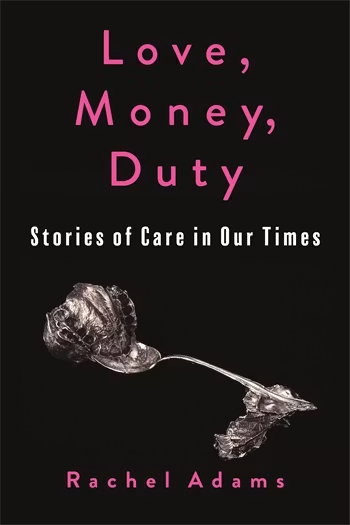
Love, Money, Duty: Stories of Care in Our Times
(Columbia U. Press), Rachel Adams
This book explores the stories we tell about caring for infants, children, the elderly, and mature adults who need it. Drawing on stories of various authors, including Toni Morrison and Susan Sontag, and stories from her own experience, Rachel Adams explores both the self-fulfillment involved in caring and the burdens and negative feelings it also often entails. According to the publisher: “From the universal dependence of infancy to elder care and from the intimacy of home and family to institutions like hospitals, nursing facilities, and asylums, Love, Money, Duty considers our ambivalence about vulnerability and need, and how it is shaped by capitalism, race, and gender.”

Guatemalan Rhapsody
(Ecco Press), Jared Lemus
Winner of the Pen/Robert W. Bingham Prize, Lemus presents a short story collection about Guatemalan workers navigating life both in-country and without—and doing whatever they must to keep themselves and their families afloat. The work is wide-ranging, from tattoo artistry and the film industry to bus driving and construction. Author Melissa Lozada-Oliva writes that “In this stunning collection, characters search for love, salvation, and survival in an ever-shifting landscape. With heart, scrappiness and sense of humor . . . , Jared Lemus maps out the glory and anguish of Guatemala.”

Overground Railroad: The Green Book and the Roots of Black Travel in America
(Abrams Press), Candacy Taylor
The Green Book was known as the “Black travel guide to America” during a time when Black travelers couldn’t eat, sleep, or buy gas at most white-owned business, especially in the South but often in the rest of the US as well. It took courage to be listed in the Green Book, and Candacy Taylor “celebrates the stories of those who put their names in the book and stood up against segregation.” To Black travelers it was a God-send, saving them hours of rejection and humiliation as they traveled by car throughout the US. In the words of Henry Louis Gates, the travel guide was “a stunning rebuke of [segregation and Jim Crow), born out of ingenuity and the relentless quest for freedom.”

Song for a Hard-Hit People: A Memoir of Antiracist Solidarity from a Coal Miner’s Daughter
(Haymarket Books), Beth Howard
This is a memoir of Appalachia, a region often stereotyped as “a place to escape from, where people are hateful, lazy, and bring tragedy upon themselves.” Beth Howard has a different story to tell, both in growing up there and in an unlooked for history of the place. Howard shares the emotional wounds her childhood left her with, but also realizes the sense of justice and solidarity it bred and the inextricable bonds working-class people share, despite their differences. In her survey of the past, she uncovers “the powerful history of white Appalachians fighting alongside Black and Brown people, pushing back against billionaires who gain power by using racism to divide them.”

Why I am Not a Bus Driver
(Bad Betty Press). Ashley Hickson-Lovence
The publisher writes: “Committed to honoring the authentic and every day, the real and true, human connection is the destination in this stirring collection, and every reader has a priority seat.” Hickson-Lovence’s debut book of poetry is an ode to his grandfather. Short-listed for the Jhalak Prize in 2026, the book is a series of unconventional sonnets woven together into a history of the author’s family, the history that makes a life.

From the Free Speech Movement to the Factory Floor: A Collective History of the International Socialists
(Haymarket Books), Andrew Stone Higgins
The International Socialists trace their roots back to the Free Speech Movement at the University of California at Berkeley in the early 1960s. Those events are well known and in many ways symbolize “the Sixties.” Less well known is that many of the student radicals from Berkely went on to take working-class jobs, mostly in the industrial Midwest, where they would organize for union reform and expansion. This books tells their story with 26 memoir-like essays from workers who spent large portions of their lives in steel, auto, communications, and trucking — agitating, educating, and organizing from within the working class.

Matewan: Blood and Coal
(Hardball Press), Kevin Corley
One of the latest releases from Hardball Press, Matewan is a new fictionalized take on the events of Matewan, West Virginia, in the coal wars of the 1920s—one of America’s most explosive labor conflicts, where, the publisher writes, “courage is measured in sacrifice, and history is written in blood.” Corley, a history teacher, says of the book, based on decades of research: “History is often remembered through dates and headlines. I’ve always been interested in the people behind those events—the families, workers, and communities whose lives were changed by history.”

The First-Gen Guide to Grad School: Advice from One Student to Another
(U. of California Press), John Kincaid
Addressed to everyone from community college transfers to adult leaners with jobs and kids, this book guides first-generation college students through the mysteries of graduate school – including choosing schools, writing personal statements, and understanding timelines and funding. Helping students decode the unwritten rules of academia, John Kincaid also examines psychological barriers like financial anxiety and self-doubt. According to the publisher: “Drawing on a decade of experience running application workshops, Kincaid pairs helpful checklists and examples with candid stories of what grad school is really like.”