
Class Cultures and Social Mobility: The Hidden Strengths of Working-Class First-Generation Graduates
(Rutgers U. Press), Paul Dean
Focused on first-generation college students, Paul Dean followed the careers of these graduates in their professional worlds, documenting the cultural dissonance working-class-origin strivers experience both in college and in the workplace. What he found was “how first-gen graduates overcame hardship while leveraging unique skills – their working-class cultural capital – in college and their professional careers.” Dean argues for a balance between “the competing demands of the two class worlds” and provides varied examples. Annette Lareau endorses the book, saying it “shines a bright light on the hidden strengths people raised in working-class homes bring to their middle-class worlds.”

Sweatshop Capital: Profit, Violence, and Solidarity Movements in the Long Twentieth Century
(Duke U. Press), Beth Robinson
Ranging from the late 19th though the early 21st centuries, this book details the importance of sweatshop labor throughout the history of American capitalism, while showing the variety of resistance movements to sweating labor that workers and allies have mounted at different times and places. It is a story of effective worker organizing hemming in sweat capital for better wages and conditions only to see sweating move to different industries or different places, where the struggle begins over again. Eileen Boris endorses: “A new generation of students and activists will find inspiration in these pages that memorialize the past to generate the knowledge for making a better future.”

Goliath at Sunset
(Hard Ball Press), Jonathan Brandow
Set in a shipyard south of Boston during the height of that city’s racial clashes, Goliath at Sunset tells the story of Mike Shea, a Vietnam vet who helps organize his fellow workers across the yard’s explosive color line. Faced with a ruthless company and an uninspired union leadership, Mike leads a campaign that forces workers “to choose between risking their lives and losing their jobs.” Mike Alley of Blue-Collar Labor Media says: “It is a novel that respects labor, understands its flaws, and affirms its essential role in the fight for dignity on the job and beyond.” The author, Jonathan Brandow, worked as a shipyard welder and union activist for nearly a decade back in the day.

Garden Apartments: The History of a Low-Rent Utopia
(U. of Chicago Press), Joshua Freeman
There once was a time when a housing shortage was viewed as an opportunity not simply to house workers, but to provide healthy communities that enhance working-class lives across the board. Joshua Freeman tells the history of this time through garden apartments – low-rise multifamily residences surrounded by landscaped gardens – originally inspired by European socialist parties in the 1920s. In the 1930s New Deal reformers studied efforts in England, Austria, and Germany, and developed a distinctive form of garden apartments which became ubiquitous in the US in the 1940s and ‘50s. The trick was to provide good housing with modern appliances at low rents, and this succeeded for a while before public housing became focused on high-rise buildings to store poor people.

A Living: Working-Class Americans Talk to Their Doctor
(Melville House), Michael Stein
Michael Stein is a doctor who has wide experience of treating patients who do demanding manual labor and don’t “have the luxury of working remotely, or seated.” According to the publisher, the book was inspired by Studs Terkel’s Working and “is composed of vignettes, snap shots of people’s working lives, the dramas, disappointments and frustrations workers have with their colleagues, family co-workers, and supervisors.” But the publisher also says: “A Living is an extraordinarily powerful and poetic tableaux of working-class America at this moment when manual labor may be the final refuge in the new era of AI.”
Late Invocation for Magic
(Michigan State U. Press), Jim Daniels
The poet of the Rust Belt, Jim Daniels again focuses on issues of class and race as they play out in the streets, kitchens, backyards, and garages of Detroit and Pittsburgh. The publisher promises that “Daniels examines the tension between our idealized country and the messier cultural and economic divides, often focusing on those who can’t afford or have access to ‘magic.’” One reviewer comments that “the poetry of Jim Daniels springs from a deep well of compassion for the working class, their plundered cities and their plundered lives,” but he “finds dignity and redemption in the grace of baseball or the consolation of the human touch, spirituality in spite of churches, love in the mist of pesticide.”

An Ignorance of Trees: A Memoir in Essays
(Cornerstone Press), Jim Daniels
Covering much the same territory in this book of essays, Jim Daniels explores the dailiness of working-class life, especially in how we develop from children to adults. The publisher promises that An Ignorance of Trees “enriches the terrain of the Midwest with heart, as bruised and beautiful as ever.” A reviewer finds: “A compelling combination of swagger and vulnerability. . . alternately hard-edged and lyric. Daniels is probably the most introspective and sensitive tough guy writing today.”

The Life, Old Age, and Death of a Working-Class Woman
(Semiotext(e)), Didier Eribon
Few books about the French working class get translated into English, but Didier Eribon’s work is an exception. In Returning to Reims he used his own life story to probe, sometimes with rage, sometimes with disappointment, a larger story of French society and politics. Now he reflects on the life and death of his mother. According to the publisher, “Eribon left behind his prejudiced working-class family to become an intellectual. Looking back on his relationship with his mother, he transmutes his rage, sadness, and shame over her death into a portrait of being reunited beyond unbridgeable difference.”

Who’s Got the Power? The Resurgence of American Unions
(The New Press), Dave Kamper
Dave Kamper, a longtime organizer and labor historian, details what he calls a “resurgence of American unions” since the Covid pandemic “that changed everything.” He interviewed workers and labor leaders around the country and tells the stories of Frito-Lay workers in Kansas, Chicago teachers, Amazon warehouse workers in New York, and Detroit autoworkers. The result, according to the publisher, is “a compelling account of how, in industry after industry, strikes, protests, and bold negotiations signaled the rise of a more coordinated effort to reclaim control over working conditions.” Rick Perstein calls it: “Witty, uncluttered, and, when need be, acerbic, it is the most useful book in decades about what the labor movement is and why it matters.”

Scrip: How the Coal Companies Impoverished Harlan County
(PM Press), Charles Thomas
Wherever there were company towns, ubiquitous in coal and steel into the 1930s, there was scrip, a substitute for money that the companies used to pay their workers and that could be redeemed only at the company store. This book tells the story of how various coal companies in various coal camps in Harlan County, Kentucky, used scrip as one of several mechanisms to exploit their miners – making profits not only in the mines, but at the company store as well. It also tells the history of miners’ resistance in Harlan County, including the Battle of Evarts.

Take Back the Power: The Fall and Rise of NYC’s Transport Workers Union Local 100, 1975-2009
(Brill Academic Pub), Mark Kagan
Marc Kagan was a New York City transit worker during most of the neoliberal era from the 1970s into the 21st century. He was also a union reformer who was part of a militant leadership group that won elections enabling them to run the union. In Take Back the Power he tells two stories: the way the reformers achieved electoral power and the difficulties they had in successfully governing. With both intimate knowledge from his experience and extensive interviews, Kagan provides an insightful reflection on the obstacles and pathways union reformers face. According to the publisher, the book illuminates “key dilemmas [reformers] face, among them: fight the boss or fight the union to fight the boss; the tension between leadership and participatory democracy; and the costs and benefits of risk aversion.

Railroaded: A Motorman’s Story of the New York City Subway
(Rutgers U. Press), Fred Naiden
Fred Naiden, now a professor emeritus of classical history at the University of North Carolina, was a New York City subway worker who in the 1980s worked his way up from cleaning restrooms to motorman. Railroaded is a memoir of his experience during those years, lyrically recounting the lousy working conditions, colorful passengers, and union fights to protect transit workers. Jack Metzgar endorses, calling it a “gripping, often heartbreaking account of transit workers working in the tunnels under New York City. . . a memoir of the deplorable conditions he and thousands of others worked in, combined with a sardonic history of the crazy quilt of subway lines that never quite became a system.”
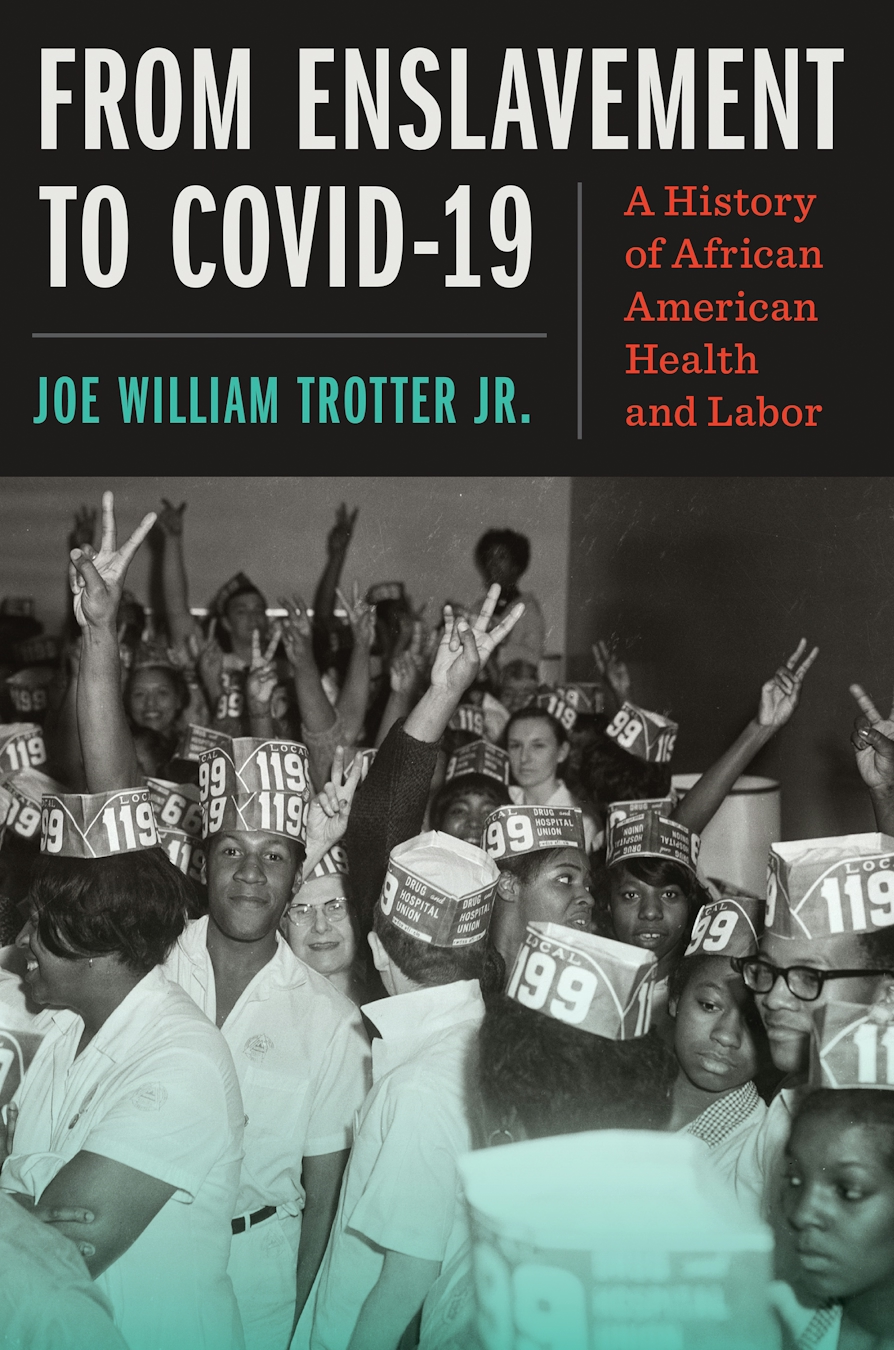
From Enslavement to Covid-19: A History of African American Health and Labor
(U. of North Carolina Press), Joe Trotter
The concentration of African-Americans in dangerous and unsafe work was widely reported during the Covid-19 pandemic, and in this book Joe Trotter recounts how continuous such working conditions have been for Blacks in the US since slavery times. It is a story of “how the labor requirements of work shaped the African American encounter with disease, how white medical professionals developed stereotypes about the susceptibility of Black people to sickness, and how those professionals denied essential medical care to the country’s most vulnerable.” In each period, however, Trotter also shows how activism and community-building both invented work-arounds and achieved improvements in how Blacks were treated in the nation’s health care system.

Our Subversive Voice: The History and Politics of English Protest Songs, 1600-2020
(McGill-Queen’s U. Press), John Street, et. al.
This volume plums the impacts of protest songs across more than four millennia in English history, examining their changing rhetorical forms and exploring the conditions of their genesis. It argues that protest songs are “a mode of political communication that has been used to confront many systems of oppression across its many genres, from street ballads to art song, grime to hymns, and music hall to punk.” Simon Frith calls it “fascinating and wonderfully fruitful” and “a model of cross-disciplinary conceptualization, treating politics as cultural activity and music-making as political activity.”

Get on the Job and Organize: Standing Up for a Better Workplace and a Better World
(Simon & Schuster), Jaz Brisack
Jaz Brisack was a leader in the Starbucks and Tesla union movements, and here recounts and reflects on those campaigns with the goal of providing a larger analysis of the new labor movement. The publisher promises: “With an accessible tone, a deep love of labor history, and profound empathy, Brisack puts recent efforts into the context of Americans’ long tradition of organizing. In the process, they show us that we, too, can improve our workplaces, from how to educate ourselves and our colleagues, to what backlash to expect and how to fight it, to what victory looks like even if the union doesn’t necessarily win.”